Before the Survey: Write the Question in Plain Words
Before the survey, turn a vague audience curiosity into one plain, neutral question that is easier to answer and more useful for decisions.
Before the survey link goes into a class group or customer email, pause over the question at the top of the page. “What do people think about our offer?” sounds useful, but it asks about too many things at once. Before the survey, write the question in plain words and decide exactly what answer you need.
For a UFM marketing project, that might mean replacing a broad curiosity about a campus event with a question about one specific part of it. The aim is not to steer respondents towards a preferred answer. It is to make the prompt clear enough that their answer can inform a decision.
What makes a survey question too vague?
A vague question often hides several decisions inside one sentence. “Do students like the event?” might refer to the theme, venue, timing, activities or communications. A respondent can like one and dislike another, yet the question gives no way to say so.
Look for broad nouns such as “experience”, “quality” and “appeal”. Ask what observable part of the offer each word refers to. If the team cannot agree, the prompt is not ready.
Also watch for questions that assume familiarity. Someone who has not seen a campaign cannot give a useful opinion on its design. A question about a service should not quietly imply that every respondent has used it.
How can you turn curiosity into one clear question?
Start with the decision, not the wording. Write down what the team might do differently depending on the answer. If no decision could change, the question may be interesting but unnecessary for this survey.
Then name the audience, the subject and the response you need. Keep the prompt focused on one subject, and use ordinary language rather than internal marketing terms. A question should not ask respondents to assess several features in one breath.
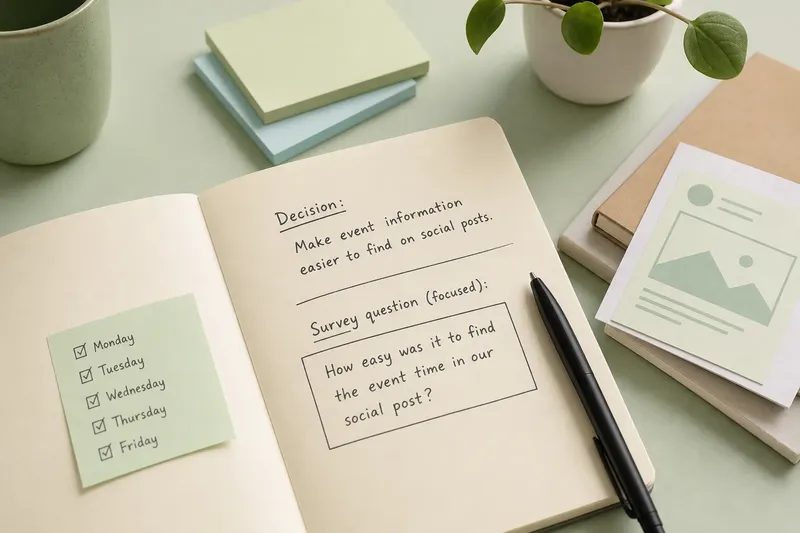
Imagine a student team deciding whether to make event information easier to find on its social posts. Its first draft is, “How do you feel about our event promotion and the event itself?” The team narrows the subject to information visibility and writes: “How easy was it to find the event time in our social post?” The answer now relates to a specific communication choice, without telling the respondent whether the post was good.
Keep the draft beside the decision it is meant to inform. That makes drift easier to spot.
What should you do during a week of question drafting?
A short routine gives the team room to clarify the purpose, inspect the wording and make a considered edit. The sequence below suits a small student project or a compact marketing team.
- Monday — name the decision. Write one sentence describing what the team may change after reviewing responses. Keep it concrete, such as choosing which event detail to make more prominent.
- Tuesday — collect the real curiosity. Ask teammates to write the question they genuinely want answered. Do not polish the wording yet; note where versions combine different topics.
- Wednesday — narrow the subject. Choose one audience and one aspect of the offer. Replace broad terms with the specific item people can recognise, such as a post’s event time or a sign-up page’s instructions.
- Thursday — check neutrality and answerability. Remove praise-seeking language, assumptions and wording that suggests a preferred response. Confirm that respondents can answer from what they have seen or done.
- Friday — read it aloud and revise. Ask a colleague who was not part of the drafting discussion to explain what the question is asking. If they interpret it differently, revise the sentence before building the survey.
If the intended audience or decision changes during the week, return to the first step. Editing the sentence alone will not fix a mismatch in purpose.
What question checks should you make before launch?
Does the question ask about one subject?
Check for the word “and” joining two different things, such as an event and its promotion. Split the prompt or choose the one subject tied to the decision.
Does the wording assume an answer?
Look for praise, blame or a suggested benefit built into the sentence. Replace it with a neutral description of the subject being assessed.
Can the intended respondent answer it?
Consider whether the person has seen or used the item named in the question. If not, add a suitable screening question or ask about awareness instead.
Will the answer help with a real choice?
Connect each possible response to a decision the team can make. If every answer would lead to the same action, remove the question or rethink its purpose.
When should you revise instead of sending the survey?
Revise if a question depends on a term respondents may not know, blends separate topics or asks for an opinion without naming what is being judged. Also revisit it when the response options do not match the prompt: a question about how easy something was needs options about ease, not general approval.
For a question whose answer depends on a product label, the survey platform’s instructions or local rules, check the relevant source once before launch. Keep the rest of the wording focused on the audience’s experience rather than adding unnecessary caveats.
Before the survey, a plain-language question gives a respondent a fairer chance to answer the thing the team actually needs to understand. Save the final wording beside the decision it supports; when that decision changes, review the question before reusing it.